‘Things I wish someone had told me during my PhD’ is a fantastic post from the always-interesting, thought-provoking, and fab feminist academic blog Hook & Eye. Although I’m in the home stretch of my PhD process now (even if it is a long and winding stretch), I’m making it my business to take as much of this advice as possible. It is never too late to prepare yourself for life on the other side of the doctorate!
Looking up
It is important to keep working on the thesis even when I don’t feel as though I’m making much progress, and I kind of feel the same way about this blog. I’m trying to keep posting even though I struggle to find something meaningful to report. It’s an exercise in momentum.
The coding software detour was frustrating and not all that productive. and to be honest I’m not completely sure that I’ve figured it out even now. I coded an entire focus group with the new software and then realized that it didn’t actually do what I wanted it to do which was a lesson in reading the manual before starting to use the system. This is something I struggle with. I like to jump in and ‘learn on the job’ and sometimes there is a downside to that approach. I wanted software that would allow me to code at least three levels deep and to collate the coded sections in each category and allow me to see them all together/print them off. So, I was back to the old software, Weft, which I am anxious about because there is no technical support. I copied each thematic category from the first focus group and pasted it into a word doc. Now, I’m going through them and making comments using track changes. It’s pretty unsexy in the tech. department but I’m actually finding that it’s working for me in terms of identifying recurring discourses. I’m making notes in another word doc. My plan now is to keep layering on for each section and each focus group. I like the layering process and I think it’s interpretive and careful which is important to me. It is also really f***ing slow which scares me a bit but I’m hoping for momentum.
So, I guess things are looking up in that sense, or at least not completely at a standstill. I thought of the post title though because I have found myself, actually, looking up all day today. I was out and about with the girls for most of the day. We went to the splash park which was pretty scary. A zillion kids and parents (some v. organized parents), the car park was jammers. Anyway, planes would catch my eye every now and again. For some reason, I always wonder, when I see and airplane, where it is that it is heading, what are the people on the plane thinking and feeling about where they are going. Later in the car, when we were driving home, I saw a couple more in the sky and it kind of made me vaguely nostalgic. I mean, I still travel fairly frequently, but I used to travel a lot, and I have spent a lot of time in airports and on planes. I hate flying but I like airports, especially the waiting at the gate part. Which is kind of weird when you factor in that I’m waiting to do something that I don’t like to do. I should add that I am talking about being in airports sans kids. Solo preferably, with a good book or magazine. It wasn’t just the planes today, I was looking at the beauty of the sky, the trees (it baffles me how Calgary goes from a bunch of dry brown sticks out of the snow to lush greenery in what seems like a couple of days). In all of this the thought crossed my mind: this must stop…all this looking up and out. I must look down, down into my transcripts, into the abyss of the thesis. I must turn away from the world for a time to get this done. So hard to do.
Motivated Monday (not at all)
So, I may have mentioned this already, Monday is the only day of the week right now where I have childcare for R&Z and it is the day where I should be making great progress on my thesis. Today, not so much. I did some grocery shopping this morning, and then my mum phoned and we hadn’t talked since last week, so we talked, and then it was so sunny outside, and I’m reading a really fabulous book (still reading the one I talked about before for the highly anticipated feminist book club), so I have been outside on a deck chair reading and sunning myself. I wrote one measly paragraph before I slid out the back door and on to the deck. I wrote about how complicated it is to code for something as slippery as ‘value’. Sure, we talk about value with the language of judgement – what is ‘good’ or ‘bad’ – we talk about what we like or what we don’t, and paint ourselves through our associations and tastes if we have the privilege and time to do so. But, so much of our expressions of value are cumulative, implicit, subtle shades that can’t be so easily picked out of a transcript, highlighted, coded, cross-referenced…. I’m torn between the understanding that my analysis must (serious voice) above all, be systematic, and a growing realization that this is often a smokescreen for something that is perhaps unavoidably arbitrary, or at least based on intuitions more than I can ever dare to admit. So, while I struggle to reconcile my duty to systematic coding with complex data which struggles against the yoke of ‘units of analysis’, I sit outside and read.
Back to Work and Good Advice
When I boxed up my papers and organized my digital files before I took my last maternity leave, I did not know if I would return to this project. I had become very disillusioned with the process, unconvinced that there was any ‘point’ to finishing, and had started to put out feelers into other areas of work. It was a complete surprise when, about two months after Z was born, I decided to start poking around in my files on the computer and began to think about my thesis work with renewed interest. When I had gone on break I had done some coding of my data and was beginning to write some notes for my findings chapters. Since I’ve been back at work properly (since January this year), I have been working to get back to that point and to be able to pick up the coding and analysis again, but from a more confident, secure position. I have spent the past few months working back and forth between my methodology chapter and my theory chapter. In this, I really see that (for my project at least) this work is not linear at all. When I wrote a draft of a project plan at the beginning of the year, I envisaged myself working through drafts of chapters in turn…working on one draft while another went to my supervisor for comments. It hasn’t really worked that way. Yes, I’ve sent work for comments and feedback, but they have not been ‘complete’ drafts. I have found that in order to work through the methods chapter, I really had to revisit the theory chapter and I have done a lot of back and forth with the two. The result is that I feel more secure with the theoretical framework, and have a clear idea about how it feeds into the methodology and the methods. Which brings me to the first piece of good advice I have received lately.
I have a very good friend who has finished her doctorate and who has been such a fantastic support as I work on mine. She told me that she feels that a major weakness in a lot of the scholarly work in our field is an unclear connection between theory and practice. ‘Make sure that you can see your theory run throughout your thesis’, she said (or something to that effect). It really stuck with me and the more I worked on my methods chapter, the more I realised that I needed to revisit my theory. I went back, did a little more reading, some re-reading, some writing, and then brought it into my methods chapter. I find that if I read something that works for me, I need to incorporate it into the thesis right away or I will forget it. Use it or lose it. Taking notes is only useful if I use them quickly and file them well.
Side note: Bad filing (weak naming/lazy folder organization) has cost me time in the past for sure. Right now I have a pretty good system and I update my document names each month so that I can see which are my latest versions.
In this way, I have fleshed out both the theory and methods chapters. Now, I am trying to get back to the actual analysis. I want to draft the analysis chapters over the summer and I need to get in and do the next round of coding right away. I do want to make sure that I’m doing this work intentionally and not randomly categorizing things. So, the second piece of advice comes from a really great article I read ages ago and re-read the other day. ‘Discourse Analysis Means Doing Analysis: A Critique of Six Analytic Shortcomings’, in a journal called Discourse Analysis Online. It’s a great piece and extremely practical for someone like me who is doing DA on qualitative data (interviews and focus groups). A lot of what I have read on DA is intensely theoretical and, while it’s useful, I have really been craving something I could use as a starting point for plotting out my strategy in a really straightforward way. Right now, I am holding the question ‘Are you actually doing analysis?’ in my mind while I plan my approach and get started on the next round of coding. It is really helpful. Antaki, Billig, Edwards, and Potter (heavy hitters in the DA scene), run through six common mistakes made by researchers and writers using discourse analysis as a technique and explain each one clearly. It has been reassuring to me as I jump back into work, that I’m not fumbling around in the dark, or at least I don’t feel as though I am, as much as I was before this break. So, armed with a clearer idea of what it means to do discourse analysis in a mindful and strategic way, and an idea of the two phases I need to complete over the next few weeks, I’m jumping back into the data and am getting started on the coding (and then analysis). I also have a list of questions I am asking of my data, questions drawing directly from theoretical framework. It has taken me a long time to figure this out – too long – but it’s good to be here.
Reading and writing
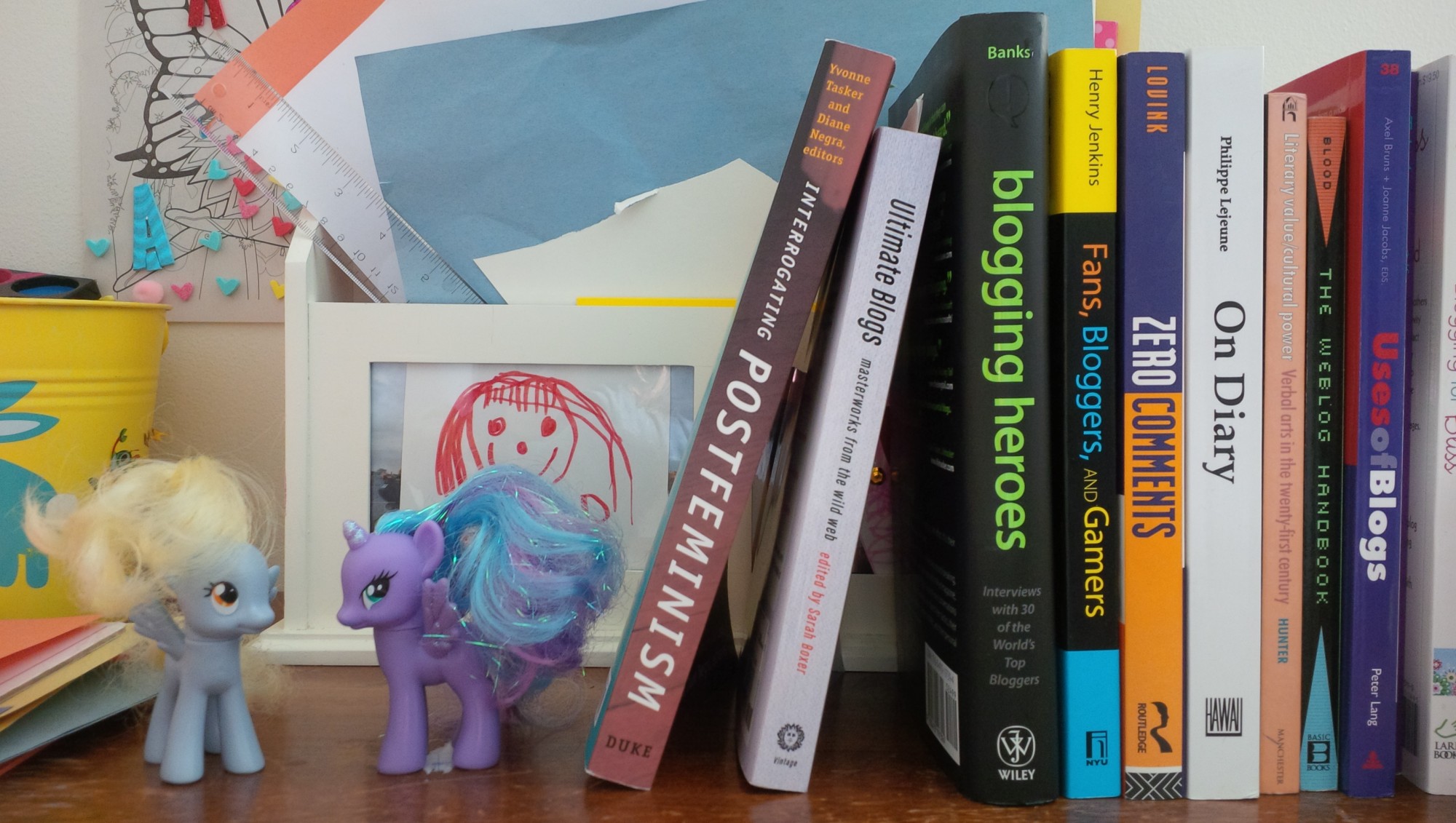
When I was a little girl I read all the time. I read through the summers, lying on my bed with the curtains closed while other kids played outside. Sometimes I would play too, but more often than not I was reading. I read all the Enid Blytons, then all the Nancy Drews, then Agatha Christie murder mysteries. In my early teens I loved a good murder mystery. Then I went to university and studied English Lit. and I kind of stopped reading for fun. I enjoyed reading for uni, I loved (and still love) Shakespeare, Victorian literature, and modern American poetry. After I left Ireland and especially when I was backpacking a lot, I read a lot too. We passed books around in the flat we shared in Sydney, Australia. A friend introduced me to Tom Robbins and a battered copy of Jitterbug Perfume became a symbol of a special time in our lives. However, since I started graduate work I have read very little. Embarrassingly little. My bookshelves are occupied by four broad kinds of books: reading for my thesis and other academic pursuits; my husband’s books; my kids’ books; books given or loaned to me. The last are nearly all unread (at least by me). There are one or two books sprinkled around the house that I actually have read. There are some parenting books in the drawer of my bedside table. There are a few guiltily-concealed ‘chick lit’ novels around too. But since I’ve been in Calgary I’ve been (apart from the first year) doing this blasted doctorate and I have hardly read for fun at all. Most of my fun reading seems to take place online. I read personal blogs: lifestyle blogs, ‘mommy blogs’, feminist blogs, blog-critique forums, celebrity gossip blogs. Most of this is at least partially in the name of research, or at least I can write it off in this way (like a businessperson writing off a lunch with a friend as a ‘meeting’). However, to be honest, it really bothers me that I don’t read any more and I think it shows in my own writing. Sometimes I wonder if part of the reason that I am struggling so much to write my thesis is that I am not reading enough. I’m also an enormous hypocrite – I have told so many students who were having trouble with writing to make sure that they are reading, and I haven’t been smart enough to take my own advice. I put it down to a lack of time but I spend hours and hours reading blogs. Even if that is ‘research’, I can surely cut back by half and use that time on some literature.
So, with this in mind, I started a book club. We haven’t met yet but we have chosen our first book (Americanah by Chimamanda Ngozi Adichie). It is to be a ‘feminist book club’, and I am pretty jazzed to have the chance to sit around and talk about feminism and books and feminist books and life with a bunch of women. I am also glad to give myself a kick in the arse to start reading again. I miss it. I miss the freedom of it. It is a window out of myself. I’m not sure what it has to do with getting my thesis done but it’s been on my mind and I wanted to write about it. I guess I hope I can become a better (and, faster!) writer.
On listening to conference presentations
I’ve had this on my mind since the conference I went to last weekend. It’s not really a fully formed post but I thought it best to get it down and perhaps even post it before I forget entirely.
I think I mentioned in my last post that I kind of read my paper at the conference, and that reading papers is not something that feels comfortable for me. I prefer to speak to a set of slides, to have a rough script memorized, and to ad lib a bit too. However, what I want to write about today is the experience of watching and listening to others’ presentations.
I am a sucker for an engaging presentation style and a presenter who speaks to the audience about her work, rather than one who reads a paper. I really enjoy getting a look behind the curtain of the process of a research project, rather than at a slick veneer of completion and I find that a conversational tone and some visuals really helps with getting me engaged. I want details about the process: it’s challenges, frustrations, triumphs and, at the end of it all (or at least at the point at which the researcher has said ‘enough’), its findings…that is what I love. When I see someone settle in to read a paper (which seems to me to suggest a complete and ‘finished’ piece), head down, hands gripping the sides of the stack of papers, I sigh a bit and, to be honest, I find myself tuning out a bit. Of the presentations I saw last weekend, easily over half of them were read papers, and I started to think a bit more carefully about my response, and my practice as an audience member.
The time slot was about 15 or 20 minutes for each presentation. It’s not a lot of time. Surely I could listen for 20 minutes? I fought my urge to self-distract and really tried to tune-in. With some papers, it was a real struggle. I feel strongly that if you are going to lean on a complex arrangement of theory, or if you are going to talk about a fairly obscure text, that then slides of some kind really can help the audience to grasp concepts, or imagine a world. However, having said this, I also think that it is good to think about just how difficult listening can be at a conference. I guess I can only speak for myself here, but I freely admit that I struggle to just listen. Sure, I can put on an ‘interested’ face and nod and smile in all the right places, but that is not listening. Half the time, at least, I’m furtively trying to formulate some kind of clever question to ask, or suggestion to make. I try to take notes and that kills the listening too. I never re-read those notes so I have no idea why I take them. After thinking about this a bit more, I come to believe that part of my problem with listening at conferences is that I have a huge desire to make the presentations of other participants, in some way, about me. I get nervous at conferences, eager to make good impressions, to legitimize myself in some way, and my bloody ego gets all fragile and out there and bloated and clumsy, and I can’t settle myself enough to just sit and listen. I don’t have to make a comment, i don’t have to be smart. I just need to listen. Harder than it might seem. I’m going to really work on it this year.
Answer the question!
When I was teaching , my first piece of advice to students who were getting ready to write an exam or an essay was always to ‘answer the question’. With each class, I would go on at length about breaking down questions, making sure they understood what was being asked, and then putting together a clear response. Well, yesterday I completely dropped the ball when it came to taking my own advice.
I was co-presenting a paper with a friend at a conference. I think the paper was good and the presentation was not bad either (although I am not a huge fan of ‘reading’ at conferences, which is something I’m going to write about in more detail another time). Anyhow, then it was question time. I get excited at question time at conferences. I like asking questions and making comments, and I really like it when someone asks me a question. Anyhow, most of the questions were directed towards one of the other presenters, but finally there was one for us. I do not know what came over me but for some reason, my brain disconnected from ears at the moment the guy asked the question. D (my co-presenter) responded and then he repeated part of the question and she threw it to me. What I should have done, and what I usually have no problem doing, is to ask him to repeat and clarify what he was asking, but for some reason I just gave a big deer-in-headlights face and babbled something completely unrelated, and smiled. He shifted around uncomfortably, obviously decided to spare the fool any further torture and said ‘thank you’. Yikes! I was mortified.
I know that this is an inconsequential moment and probably means nothing to anyone but me but my mind is screaming out ‘fix it! fix it! make me smart again!’. Urg. I even have thoughts of submitting work to another conference just so I can have a do-over.
However, I cannot do this because it would suck at least a week of work-time away from the thesis and also because it is quite silly. My ego is bruised because a bunch of people got to witness me not being smart. Poor me.
So, it’s a reminder…answer the question, and if you don’t twig exactly what the question is, then don’t brain-fart and start babbling – ask for clarification, take a moment to think, and then respond. You can always offer to discuss the question after the session if you feel there is a lot more to be said/you are having trouble being succinct on the spot.
American Blogger
Last night I watched the documentary film, American Blogger. I heard about the film last year on the blogs of some of the participants and I was quite excited about it. I was excited partly because I was keen to see some of these bloggers offline, on film. I was also excited, because I had read Casey Wiegand’s blog (she is the film-maker’s wife and blogs about their family) and I was curious as to what Chris Wiegand would come up with. I was concerned when I saw who some of the participants were that there would be a lack of diversity (and a lack of awareness about how that was problematic) and, when it came out, the trailer seemed to confirm my predictions/worries. With a pompous voice-over (which would actually be kind of funny if it weren’t so cringy), it presented a hugely inflated sense of its own importance, and (in its first iteration, especially) of self-awareness when it came to the limits and omissions of the project. Appropriately (I think), there was plenty of critique: Technology Tell, called the trailer “unintentionally horrifying”, and the forums at GOMI went to town. Since the initial trailer release, the film has been re-positioned as ‘American Blogger – the first journey’, a qualification to the title which indicates that there may be further films, possibly covering more extensive and diverse communities in the American blogsophere. This, among other changes, suggests that the film-maker has taken some of the critique on board.
To the film itself. I find blogging culture so fascinating (I have, after all, been studying it for a decade now), that i was glued throughout. The film is too long. It’s two hours long and could easily be edited down to 90 minutes. It is also a bit all over the place, I was often unsure where in the United States the blogger CW was talking to, actually was. And this situation of the participants is, I think, important, or could have been important. Wiegand presents the film as a road-trip and it would make more sense to follow the sequence of the road trip in the film more explicitly than he does. Although there were several bloggers that I read regularly in the film, there were also a whole bunch I have never heard of and I would like to have seen blog-names on-screen when they were talking so that I could access the blogs quickly. All of these criticisms were also made by viewers chatting on the GOMI forum (it is always so interesting to me how these forums are treated with such disgust by a lot of bloggers when I think that the critique and advice to bloggers is often really insightful and potentially useful).
Aside from the technical/format issues I had with the film, what of the bloggers? Well, this is a pretty homogenous group of mostly white, mostly middle-class, women bloggers. Their blogs seemed to fall into the family/fashion/food/lifestyle zone and there were instances where I chuckled to see how similar some of their decor/clothing was. There are definitely dominant trends that run through blogging communities/categories, and there was a whole lot of chevron/gray/statement necklaces/manicures/bright lipstick among the participants. Lots of cute children and a bit of cultural appropriation. What struck me most was how the film points to just how professional blogging has become. Blogging, as it started, was amateur, with no profit or professional potential in sight. When I started studying blogging in 2004, I was looking at feminist academics who blogged, and how blogging operated as a form particularly suitable for feminist thought and activism. The risk, as I saw it then, was that blogging was also potentially career-damaging, and in academic life (where secure jobs are a rare species), this possibility could serve as an invisible and insidious editor in a environment where the lack of editors is seen as central to its identity. Now, ten years later, I see professionalism as the loudest editor. Several of Wiegand’s subjects maintained that they enjoyed the freedom to post whatever they wanted, that they saw themselves as autonomous owners of their online ‘real-estate’, that they could share freely. I’m not convinced. At the same time, they were shown taking outfit photos where outfits were chosen and shot to foreground c/o pieces received from a blog sponsor. In 2012 I spoke at a social media conference in Vancouver about authenticity and professionalization in blogging culture. It’s something I am still writing about and will be talking about at the PCAC conference here in Calgary next month. This film produces a whole host of new examples for me of how the concept of authenticity is lauded as central to blogging culture when, at the same time, the lives and selves we see on blogs are increasingly crafted and styled and co-opted by business interests. The business owners in the film talked excitedly about useful bloggers were for reaching potential customers. Bloggers have the trust of their readers, they are seen as ‘authentic’ in a way that traditional media advertising is not. So, many of them become instrumental in promoting business interests. The ‘authentic’ blogger identity is carefully cultivated in order to generate trust and to attract sponsors. This is certainly not the case for all bloggers but I see it a lot in the blogging communities I study and it was up-front and center in Wiegand’s film.
Z is surely going to wake up from her nap in a few minutes so I’m going to wrap up this initial commentary here. I found the film fascinating, but for someone without my rabid interest, the length and wonky editing might be too much to push through. To be honest, I even appreciated the missteps because they show a lack of polish and reveal something about the assumptions of the film-maker. It was nice to see some of the bloggers I read, on film. Melissa Jordan from Dear Baby comes across as critical-thinking and self-aware, both in the film and in her blog-post about the film. I am going to build a commentary of the film into the introduction and conclusion of my thesis, so I am very grateful for it and for the fresh burst of excitement it has given me about my own project.
Failing
I’ve been waiting for some words to magically appear on the screen/page and that hasn’t been working out so I thought that I would force myself to sit down and write a post. So. Our trip to Vancouver was a lot of fun and it was great to see friends and have time together without work/school/errands/chores. There is truly not much better in the world than seeing your children play with your friends’ children.
We have been back for two weeks and I got stuck into that list of to-do’s that I made before I left. The list was a big help. I had been through the sections I was working on and made some notes there too (I find that if I bold the notes and make them a bright colour, it helps me to see at a glance where I need to pay attention). I started in on the list and then, I don’t know, I just lost momentum. Little things started stealing my work time away and I wasn’t really carving it out. We had a week of a lot of social stuff last week and I was just trying to keep up with the kids and the house. I have also been having issues with my wrist which makes it hard to type much but it’s not a massive deal.
Today, at the end of another week of not-much-to-show I feel like I’m failing, and it’s pretty shitty. I need to figure out how to get past this though because, honestly, I don’t have time to sit around feeling sorry for myself. I have a bit of time to myself today because L is off work and has taken our eldest daughter out for the afternoon. Baby Z is napping. I am trying to force myself back on track. Or at least into the station. Interestingly, right around the same time that I stopped doing any meaningful work on my project, I also stopped exercising. I have been meaning to go swimming all week and it just hasn’t happened (see, waiting for things to magically ‘happen’ again!). My mom-and-baby fitness class finished up before we went away and Z is too old to enroll in another one. I know that there is a correlation between exercise and work for me and I need to get back on it.
So, goals for today: 1) get outside for a walk. Bundle Z up when she gets up from her nap and go out for an hour. 2)See where I’m at in the theory chapter and set a small, reasonable, writing goal to accomplish tonight. When the girls are in bed, get it done.
Long-term, though, I want to think about strategies for dealing with times when I feel stuck, or struggling to work, and start interpreting it as failure. I need to do this for the girls as much as for myself. R had a Taekwondo test scheduled today and she got an attack of nervousness and shyness and wouldn’t even try to do it. It was tough to see her sitting on the edge of her class while the other kids did the test. She seemed grand afterwards and chomped down a cupcake but I want to be able to support/encourage her to try next time without berating her. If I’m going to learn to do this for the girls, I need to be able to deal with my own struggles around performance, success, and failure. I need to develop strategies so that I don’t spend even more valuable time on self-loathing and disappointment (which never results in an uptick in productivity). One foot in front of the other. One paragraph at a time.
Taking Stock
I have been chipping away at the data gathering part of my methods section over the past couple of weeks. Tiny chips. I’m taking a short break over this weekend and early next week and I’m leaving my work in a not-so-great place. I am feeling a bit frustrated. I’m not making progress as quickly as I would like, and I’m not finding the hours to put in to make it happen. So, in a way it feels like a shitty time to take a break because I’m not finished the draft of the chapter, by any means. In another way, I think it’s an excellent time to take a break. I don’t have good momentum at the moment, I’m floundering a bit, and it can’t hurt to stop, take stock, have some fun, and then get back to it with a positive attitude.
So that is the plan. Tomorrow I should get about and hour and a half work-time in the morning. In that time I want to do the following:
– Quickly read through the chapter as it stands.
– Flag the areas that need work and identify next steps for each area.
– Update the reference list
– Identify reading required to move on
– Adjust timeline
Then I have to pack for a family of four (LJ is a lousy packer: leaves everything to the last minute and forgets really obvious essentials). Traveling (even when it is a relatively local trip) with kids is sooooo different from traveling without them. I am excited though – on Thursday evening I will be drinking beers with some pretty awesome women that I haven’t seen for a while. I’m going to get to meet some new babies and introduce friends to baby Z. Yes, perhaps a holiday is just what I need.
